Oxygenation Optimization & Retrofit Specifications
The 70% Problem.
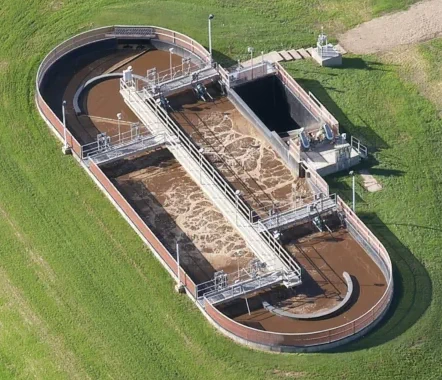
In standard municipal wastewater treatment plants (WWTP), the oxidation ditch is the single largest energy consumer, typically accounting for 70% of the facility's total electrical load. Traditional surface aerators (rotors or brushes) are mechanically inefficient because they couple two distinct functions: aeration (introducing oxygen) and propulsion (keeping solids in suspension). This mechanical coupling forces operators to run motors at high speeds to maintain flow, often over-aerating the mixed liquor and wasting massive amounts of energy. Our comprehensive retrofit achieves operational energy savings of 40-60% through a multi-faceted approach. While decoupling aeration and mixing provides some efficiency gains, the majority of the savings stem from our proprietary process control and oxygen delivery system that optimizes the underlying biological reactions.
The "Supercharged" MLE Process
To optimize the Modified Ludzack-Ettinger (MLE) process, we must separate the variables. Our design retrofits existing ditches with independent mixing and aeration modules. This Decoupled Control Architecture allows operators to dial in the exact DOx levels and flow rates required for suspension with our system maintaining stable conditions.
The key to a high-performing MLE process is a stable Anoxic Zone. In traditional systems, it is difficult to maintain mixing without introducing oxygen, which disrupts the denitrification biology. Our system achieves maximum process efficiency with separate controls over aerobic and anoxic zones, the anoxic zones continue mixing without oxygen aeration ensuring solids stay suspended while nitrate respiration occurs undisturbed. This stabilizes pH naturally and recovers alkalinity, reducing chemical costs.
Municipal flow rates fluctuate wildly between day and night. Our variable-input system allows the plant to match energy expenditure to biological demand in real-time by ramping down aeration during low-load periods while maintaining hydraulic flow.
Drop-In Deployment. No Civil Works.
Infrastructure upgrades historically mean expensive concrete pours, crane operations, and risky plant shutdowns. Planetary Prototyping changes the equation.
- Minimal Shutdowns: Our modular units are designed to be installed with minimal downtime, often while the ditch remains active.
- The Liner Advantage: We utilize high-durability geomembrane liners to modify ditch hydraulics without altering the concrete structure.
- Optimized Equipment: We replace aging, energy-intensive rotors with streamlined, submerged propulsion and fine-bubble distribution networks.
The Oxi-LOTL Design
Oxidation
Loop
Optimized
Treatment
Liner
Our system mascot, the Oxi-LOTL, is inspired by the axolotl, a creature with remarkable abilities that mirror our design philosophy. We don't just install new equipment; we regenerate existing infrastructure.
- Regeneration & Retrofits: Just as an axolotl can regenerate entire limbs, our liner-based system retrofits and revitalizes aging concrete basins without costly demolition.
- External Gills & Oxygen Optimization: The axolotl's external gills are a hyper-efficient breathing apparatus. This reflects our proprietary gas transfer interface, which maximizes oxygen delivery far beyond the capabilities of legacy aerators.
- Thriving in "Muddy" Water: Axolotls are native to complex, turbid lake environments. Our system is built to thrive in the challenging, solids-rich environment of municipal wastewater, maintaining peak performance where others fail.
The core of the Planetary Prototyping system involves a proprietary method for maximizing the oxygen transfer efficiency (OTE) within the fluid column. The specific engineering mechanisms are redacted from public viewing due to pending patent applications.
Continue Exploring
Academic Foundation
Dive into the core research and thesis.
Home
Return to our main page.